
Ask why cladding is coated on all six faces and the usual answer is “for consistency.” That is true, and it is the least interesting reason.
The real reason is that wood does not absorb water evenly, and the two surfaces that absorb it fastest are the two nobody looks at. Crisp seals every board on all six faces with a premium waterborne multi-coat system before it ships, and this article explains what that is actually buying.
Why end grain is the weak point
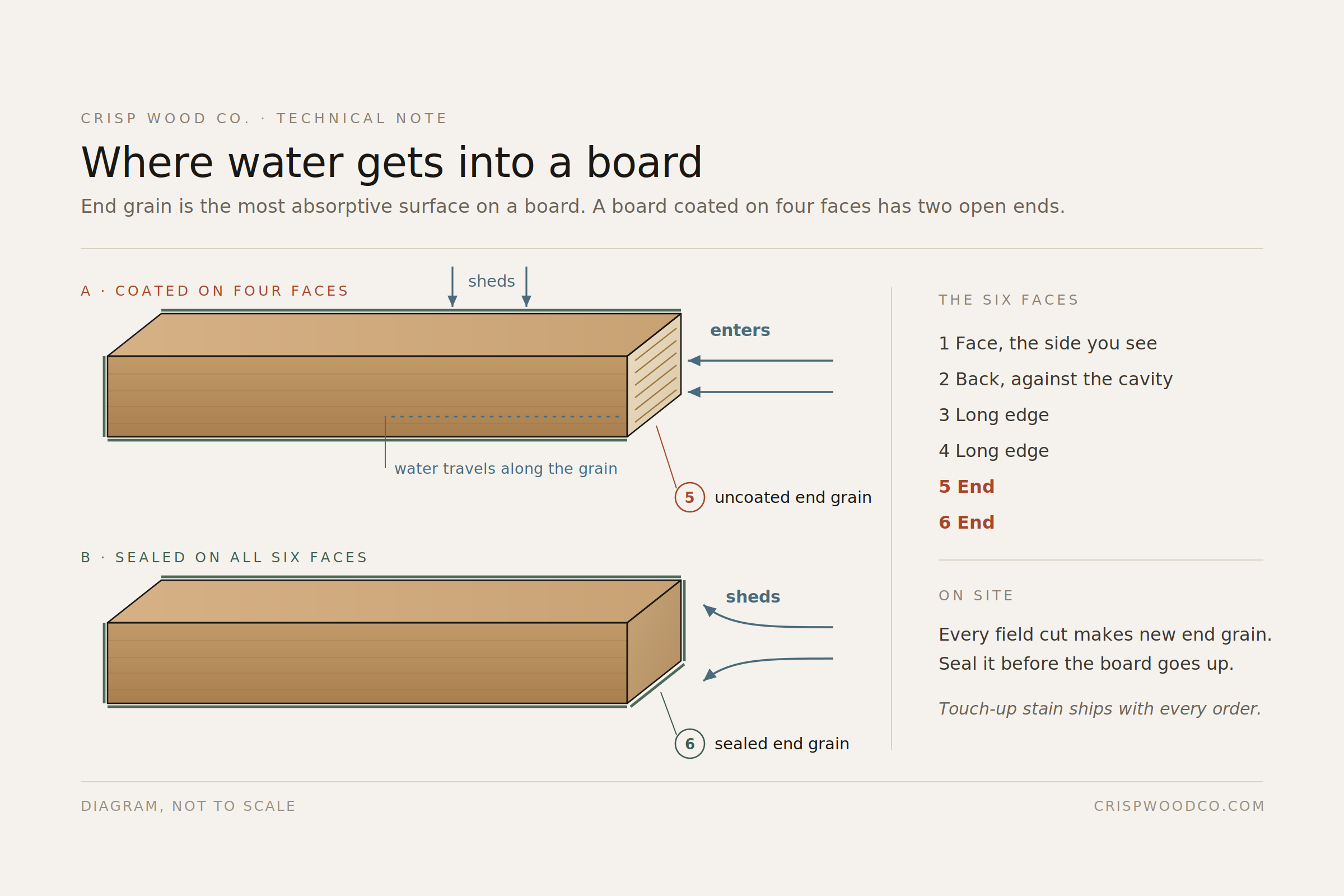
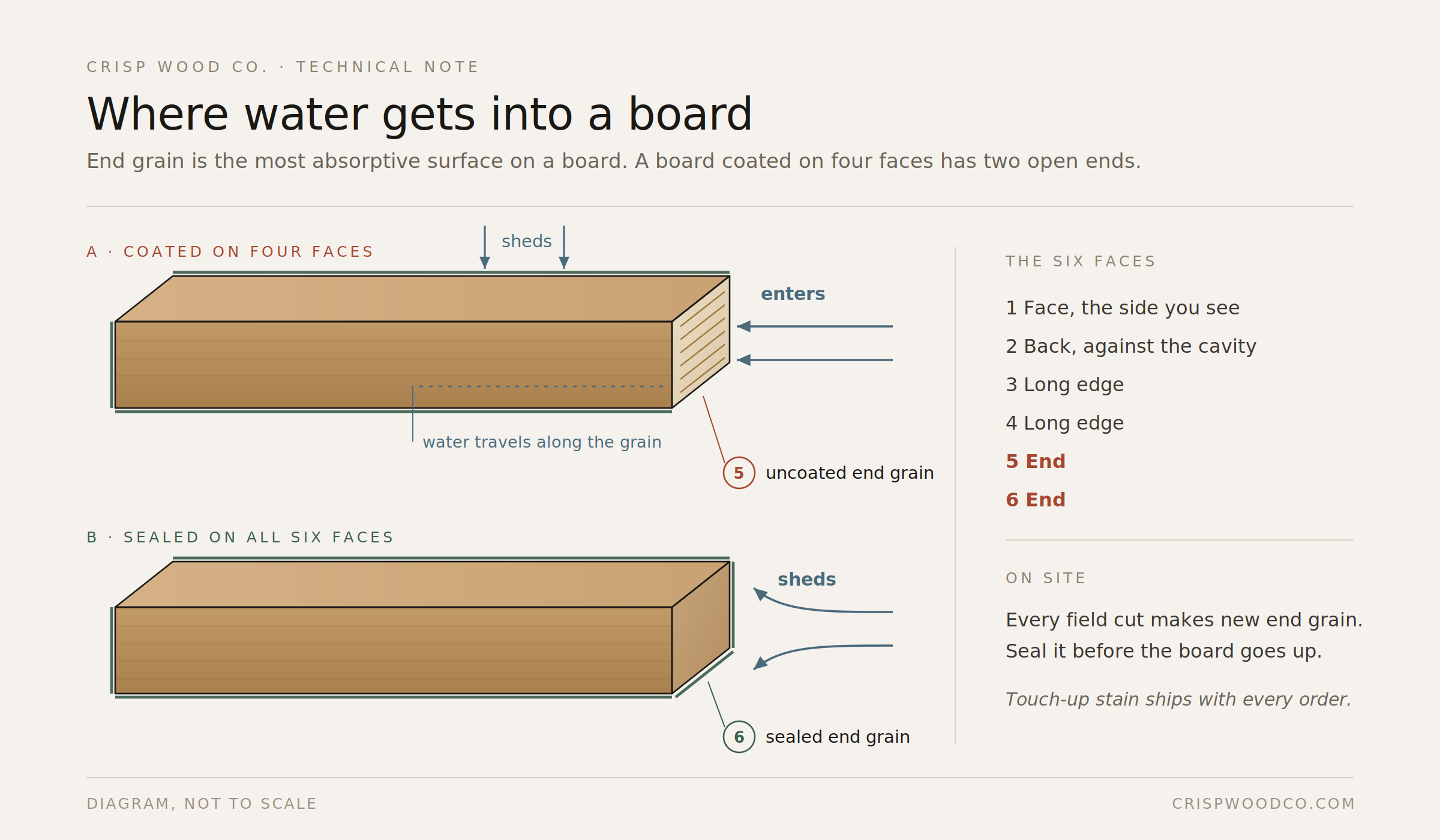
Wood moves water along the grain. The cell structure runs lengthwise, so a cut end is a bundle of open tubes rather than a closed surface.
FPInnovations says it plainly in its guidance on managing moisture on Canadian construction sites. End grain is the most absorptive surface on a piece of wood, and it is the route by which water travels deepest into it. The report’s instruction is blunt: for any species and any product, end grain deserves special treatment.
In practice that means a board coated on four faces is a sealed container with two open ends. Water that lands on a coated face mostly runs off. Water that reaches a butt joint, a corner, or the bottom edge of a board goes in.
What that looks like on a building. It looks like failure that starts at the ends.
Coating lifts first within an inch or two of a butt joint. Boards cup near the ends while the middle stays flat. Dark staining appears at the base course and nowhere else. A wall that looks sound from ten feet has a row of soft ends behind the trim.
None of this is the coating failing on the face. It is water entering where there was no coating, moving into the board, and pushing back out through the film from underneath.
It also compounds. End grain that wets and dries repeatedly checks, checking opens more end grain, and the rate of uptake goes up rather than down over time.
Why the back of the board counts too. The cavity side sees humidity swings the face never does. An uncoated back takes those swings up unevenly, and a board that is absorbing on one side and sealed on the other is a board that wants to cup.
Why the sealing happens before the board ships
Sealing six faces is only practical in a controlled setting. The board has to be at a stable moisture content, the surfaces have to be clean, and the coating has to cure at a known temperature before the material is stacked.
A board coated on all six faces under those conditions arrives at the site with no untreated surface on it. The tongue, the groove, the back, and both ends are covered.
The one place that protection can be lost is the saw.
Every field cut creates new end grain. Every one of them has to be sealed before the board goes up. This is the single most commonly skipped step on a cladding install, and it is the one most likely to show up as a callback two winters later. Every Crisp order ships with a gallon of touch-up stain matched to the colour for this reason.
A few conditions worth putting on the drawing, because they are easy to lose on site:
- Apply between 5 °C and 25 °C, ideally around 21 °C
- Not in rain, frost, direct sun, or onto warm wood, and keep the material above 1 °C for 48 hours afterward
- Brush it on with a natural bristle brush and work it into the surrounding surface
- Touch dry in 2 to 8 hours, recoat after 12 to 48 hours depending on temperature
Where six-face sealing sits in the wall
Six-face sealing is not a substitute for the rest of the wall. It buys time at the one place water is most likely to get in. The cavity behind the cladding is still what decides how quickly a wet board becomes a dry board again, and the clearances at grade, roof and deck are still what keep standing water and splash-back off the ends in the first place.
Think of it as the order of operations. Shed the water, ventilate what gets past, and make sure that when water does reach a board, there is no open end for it to climb.
Crisp supplies Western Red Cedar, Western Hemlock and Lunawood sealed on all six faces, with touch-up stain included so the site can keep that protection intact.
Order samples at crispwoodco.com/samples.
References
- Wang, J., On-Site Moisture Management of Wood Construction, FPInnovations, published through the Canadian Wood Council. Read the report
- Crisp Wood Co. installation guide and touch-up instructions
Leave a Reply