
Complete Wood Siding Installation Guide
To print the “Installation Guide” kindly click the following PDF to download and then print –  Click here to download “Product Installation Guide”
 Click here to download “Product Installation Guide”
 General Wood Guidelines
Please read and understand these guidelines prior to
handling or installing this material.
Delivery & Unloading Instructions
Your material from Crisp will arrive at the job site via a third-party freight carrier. It will arrive in bundles wrapped with breathable lumber wrap and labelled for easy identification. There will be foam sheeting between all good faces to prevent damage to the finish.
Please note: The consignee is responsible for unloading materials.
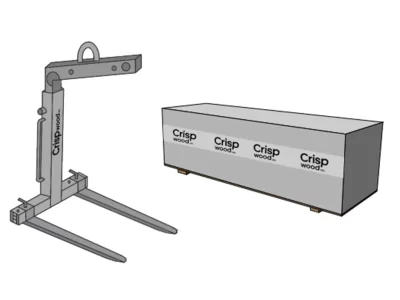
Forklift Handling:
If offloading with a crane
Forklift Handling:
- Center the forks on the lift.
- Ensure the forks grab entirely beneath the bundle.
- Use caution when unloading.
- Inspect all units for transit damage.
If offloading with a crane
- Forks are mandatory.
- Do not use lifting straps, they may damage the wood.
- Freight claims must be reported at the time of delivery.
- Do a quick visual inspection on arrival.
- If damage is found, notify both the freight driver and Crisp immediately.
- Once safely offloaded, move bundles to a covered area to prevent weather damage.
2. Inspection
Visually inspect the material to verify quality and quantities. Each bundle will be labelled with a packing slip to identify the product within the bundle and its respective quantities.
Crisp requests that any shortages, damages, or concerns about the material be reported and documented within ten (10) days of delivery.
Important:
- Do not install any material considered defective.
- Report any questions or concerns immediately to Crisp.
- The installation of the material will be considered final acceptance of the colour and quality.
3. Proper Storage & Protection on the Jobsite
Bundles or loose pieces of Crisp wood must be stored properly to prevent damage from:
- Rain
- Direct sunlight
- Moisture concentration
- Dust or overspray
- General construction zone hazards
- Store materials under a covered area (e.g., garage).
- If a covered space isn’t available:
- Use a waterproof tarp or breathable “vapor-open” plastic to allow ventilation.
- Loosen the lumber wrap.
- Install wood spacers between the lumber wrap and wood to promote airflow and acclimation.
- Elevate materials on stringers at least 6” above ground level.
- Ensure any covering allows for ventilation on all sides of the crate.
- Re-use foam sheets to protect the finish.
4. How to Acclimate Wood Before Installation
Wood is a natural material and will respond to its environment, so proper acclimation and an assessment of moisture content (with a moisture meter) is necessary to achieve maximum performance
Why Acclimation Matters
- All exterior woods will move with climate changes.
- Wood must reach an equilibrium moisture content (MC) before installation.
- This is achieved by providing proper airflow around the wood.
- Kiln-dried woods (e.g., Cedar, Hemlock) may require up to 2 weeks to fully acclimate to its environment.
- Do not install any material that:
- Has been wetted
- Has experienced extreme changes in temperature, humidity, or exposure
5. Mock-Ups for Wood Siding Installation
Mock-up (test) areas are highly recommended by Crisp if there are any questions or concerns about the appearance or installation of the material.
Why create a Mock-Up?
A mock-up helps all parties:
A mock-up helps all parties:
- Assess the appearance of the wood
- Understand installation methods
- Develop a proper installation plan for the full batch of material
6. Fastening Guidelines for Wood Siding Installation
Fasteners
Using appropriate fasteners will directly affect the longevity and structural performance of your material. Even the best woods on the market will fail if inappropriate fasteners are used.
Crisp strongly recommends stainless steel fasteners.
Nailing Instructions
Using appropriate fasteners will directly affect the longevity and structural performance of your material. Even the best woods on the market will fail if inappropriate fasteners are used.
Crisp strongly recommends stainless steel fasteners.
Nailing Instructions
- Nails can be had-driven or installed with a pneumatic nail gun.
- If using a pneumatic nail gun:
- Reduce air pressure
- Tap nails flush using a nail set
- Nails must penetrate at least 1.25” into a solid wood substrate.
- Crisp does not warrant any material installed with improper fasteners.
- These guidelines apply to average environmental conditions.
- Extremes in heat, humidity, precipitation, or wind may require different fasteners or techniques.
- Screws can offer superior holding power compared to nails.
7. Sealing Field Cuts Before Installation
All field cuts, specially cut ends and ripped edges, must be sealed prior to installation.
- The ends of boards must be trimmed/squared up and sealed before installation.
- Use an alkyd oil end grain sealer, which can be applied and installed without fully drying beforehand.
- Apply the sealer using a foam brush or end-cut applicator.
8. Handling Prefinished Wood on the Jobsite
Please handle the materials with caution, as natural wood can be damaged more easily than other manufactured products.
- Wood is relatively soft, and the finishes can be delicate.
- Proper storage and handling is essential to minimize damage.
- For longer boards, remove from crates with care.
- Use two people at each end when transporting and installing boards.
- This reduces the risk of damaging the boards or their finish.
10 Essential Steps for Installing Wood Siding Professionally
1. Exterior Cladding
A. Ventilated Cladding System (Rainscreen)
Proper ventilation is important for all wood products. Trapped moisture or prolonged exposure to moisture can cause swelling and adversely affect the structural performance of any wood product.
A ventilated cladding system, also known as a “rainscreen” style installation, will greatly increase the longevity and overall performance of the wood and is strongly recommended for the vast majority of exterior siding installations.
This method:
This method:
- Provides an open air space between the finish and the exterior sheathing
- Minimizes exposure of moisture to the wood siding
- The exterior finish should have 8-12” of clearance from the ground.
- Top and bottom air vents should be installed to allow full air circulation around the siding.

B. Furring Strips for Rain Screen Assembly
Crisp wood siding should be installed over a standard 16” on-center stud built wall with exterior sheathing and a weather barrier over top.
In order to create an air gap for the rain screen assembly, the wood siding should be held off the exterior sheathing with furring strips, which will ensure uninterrupted ventilation and drainage behind the siding.
Key Installation Notes:
All lumber furring must be:
As always, please consult with your licensed siding installer and general contractor to determine their preferred and recommended type of furring strip & installation methods.
Key Installation Notes:
- Remove any materials that may hinder airflow or drainage.
- There are many different options for furring strips, but we typically recommend 1x pressure-treated lumber.
- Using pressure-treated lumber is optional, but should be prioritized in extreme climates with significant moisture.
- Standard nontreated lumber can be used in moderate climates.
All lumber furring must be:
- Kiln-dried
- Straight
- Without splits or nail holes
As always, please consult with your licensed siding installer and general contractor to determine their preferred and recommended type of furring strip & installation methods.
- Horizontal Siding
For siding installed horizontally, use vertical furring strips placed over each stud location at a maximum spacing of 16” on-center (see figure A).
Installation Requirements:
Installation Requirements:
- Nail the strip into the stud every 12-16” vertically up the stud.
- It is the installer’s responsibility to ensure the furring strips are properly secured to the structure.

- Vertical Siding
For siding installed vertically, use vertical counter battens to hold the horizontal furring strips off the exterior sheathing and maintain an uninterrupted drainage plane (see figure B).
Assembly Details:
Assembly Details:
- The vertical counter batten material and thickness is essentially irrelevant, as it merely serves to float the horizontal furring strips off the exterior sheathing.
- The horizontal furring strips should be a minimum 2x lumber to:
- Provide a proper fastening base
- Avoid compromising the weather-resistant barrier (WRB)

C. Starter Strip for Pest Prevention and Ventilation
In order to prevent rodent or insect infestation within the wall cavity, we recommend using ventilated “starter strips” or standard staple screening at the top and bottom of every wall.
D. Flashing for Moisture Control and Drainage
Prior to installing Crisp wood siding, please be sure that flashings are also installed to prevent moisture from entering into wall spaces.
Flashings are a critical component that:
- Directs water away from the building.
- Guides water toward the designed drainage paths
- Rain penetration through the siding
- Water vapor diffusion
- Leakage of moist air from the interior
- Condensation
- Install horizontal flashing at the top of all wall penetrations, such as:
- Windows
- Doors
- Any change in materiality or material direction
- Crisp wood siding should be installed at least ¼” above the flashing edge.
- Do not caulk where the flashing meets trim or other materials.
- Caulking in lieu of flashing is not an acceptable alternative.
E. Ground Clearance
To avoid the wicking of moisture into the wood, Crisp wood siding should never be in contact with the roof or ground.
Clearance Requirements:
Clearance Requirements:
- Maintain no less than 8-12” of ground clearance, separated by a trim board (or skirtboard) made of water-resistant material.
- Maintain a minimum clearance of:
- 1” from adjacent horizontal structures (e.g., deck, low wall, trim)
- 2” from the roof
F. Installing Tongue & Groove (T& G)
To avoid the wicking of moisture into the wood, Crisp Wood siding should never
be in contact with the roof or ground. Wood siding should have no less than 8-12”
of ground clearance, separated by a trim board (or skirtboard) of a water-resistant
material. You should also maintain a minimum clearance of 1” from adjacent
horizontal structures (i.e. deck, low wall, trim) and 2” from the roof.

G. Installing Lap Siding (Shiplap)
Shiplap siding can be installed both horizontally and vertically.
Fastening Guidelines:
- For boards 6” or under in width:
- Use one fastener, placed 1” up from the exposed lap
- For planks 8” and wider:
- Face-fasten two courses per board
- Place fasteners 2.5” to 3” apart
- This allows for expansion and contraction without splitting

H. Installing Square Edge or Smooth Four Sides (S4S)
Square siding or square trim can be installed both horizontally and vertically.
Fastening Guidelines for S4S Boards:
Fastening Guidelines for S4S Boards:
- Face-fasten two courses per board
- Place fasteners 2.5” to 3” apart
- This allows for expansion and contraction without splitting
- Due to the open joint between S4S planks, a UV-resistant weather barrier is required.
- Any lumber furring should also be protected with suitable weather-resistant joist tape.

J. Spacing
For end/butt joints, an expansion of 0.8% (65% RH – wet) needs to be considered.
General Spacing Guidelines:
General Spacing Guidelines:
- Never install boards butted up tight against any other construction elements, including wood.
- Provide approximately:
- 1/8” gap when meeting other construction elements like window & door trim, corners, or dissimilar materials.
- 1/4” gap when meeting any metals to avoid staining.
- 1/16” gap between butt joints of similar wood material.
- Always weather cut and seal these ends.
- Ensure they land over a stud or furring strip for proper fastening.
K. The Do's & Dont's Of Wood Siding
Do:
- Inspect material upon arrival
- Discuss performance expectations with Crisp Wood co
- Understand Crisp Wood co installation guidelines
- Store material in a dry and protected location
- loosen lumber wrap and allow for proper air flow while storing
- Acclimate material under normal conditions & proper methods
- Seal all field cuts
- Use proper fasteners
- Install a ventilated cladding system (rainscreen)
- Design for flashing and weeps to prevent water intrusion
- Maintain 8-12” of clearance from the ground
- Follow local building codes
- Make sure installers and anyone handling this material reads these guidelines
- Allow for at least 15% of waste due to trimming and fall out
- Allow for expansion and contraction of the wood by spacing boards properly
- Install mock-ups or test areas to assess proper installation methods
Don't
- Receive material from Crisp without inspecting
- Install without acclimating or determining appropriate moisture content
- Use staples, T-nails, interior-rated (“finish” nails) or any other insufficient fasteners
- Install damaged or defective wood. Crisp cannot warrant or replace material once it’s installed
- Install siding in direct contact with concrete, masonry, stucco, top soil, mulch, patios, or roofs
- Install siding directly to sheathing or house wrap
FAQs
A1: You should start with a weather-resistant barrier over the sheathing, then install siding from the bottom up. Remember to leave proper gaps for expansion and ventilation. Use stainless or galvanized fasteners and follow the manufacturer’s guidelines.
A2: Stainless steel or hot-dipped galvanized nails or screws are best. They resist rust and staining, and hold up well against weather over time.
A3: Let the wood siding acclimate for at least 5 to 7 days in the climate where it’ll be installed. Make sure to store it flat, off the ground, and protected from direct moisture.
A4: It is not recommended. Always install it over a breathable weather barrier and use furring or rainscreen strips to let air flow and prevent moisture buildup behind the boards.
A5: A rainscreen is a gap between the siding and the wall that helps with ventilation and drainage. It helps prevent mold, rot, and warping by keeping moisture from getting trapped.
